Rule 1: The Basics: Play Golf Fairly and With Respect

What this is about
Rule 1 is the foundation of golf: you play the course as you find it and the ball as it lies. You follow the rules and behave like a good sport.
What you need to do
- Play the ball from where it's at rest, unless a rule allows otherwise.
- Give yourself an honest penalty if you break a rule.
- Keep play moving, watch out for safety, and repair any damage to the course.
- Shout "Fore!" if your ball is heading toward others.
- Serious unsportsmanlike conduct can get you removed from the competition (disqualification).
Common mistake
Thinking you can nudge your ball a little, for example away from a twig. That's not allowed and costs you a penalty.
Example
Your ball lies on the fairway in an old divot (a chunk of turf knocked out earlier). Annoying, but you simply play it as it lies.

Practise this rule with real exam questions in the free app.
1.1 The game of golf
You play golf over a round of 18 holes (or fewer). Each hole begins with a stroke from the teeing area and ends when your ball falls into the hole. You play the course as you find it and the ball as it lies, unless a Rule allows otherwise. It can be played as match play (hole by hole against an opponent) or stroke play (total number of strokes).
1.2 Standards of Conduct
1.2a Expected behaviour of all players
Play in the spirit of the game: play fairly, consider others, leave the course in good condition, and keep up the pace of play. What doesn't fit that: showing up late, delaying unnecessarily, damaging the course, being disrespectful toward others, and ignoring the Rules. For serious misconduct, the Committee may disqualify you.
1.2b Code of conduct
The Committee may adopt a code of conduct as a local rule. Penalties for breaching it range from a warning through penalty strokes to disqualification for serious misconduct.
1.3 Playing by the Rules
1.3a Meaning of "Rules"; Terms of Competition
By "the Rules" we mean the 25 Rules of Golf, as well as the terms of competition set by the Committee. Those terms can include local rules that add to or modify the Rules of Golf.
1.3b Applying the Rules
You're responsible for applying the Rules correctly yourself. In match play, you and your opponent may settle a rules issue together, but never knowingly agree to ignore a Rule. In stroke play, if you're unsure how to proceed, play two balls and refer it to the Committee.
1.3c Penalties
A penalty removes the advantage a breach would otherwise give you. There are three levels: a penalty stroke, the general penalty (two penalty strokes in stroke play, loss of hole in match play), and disqualification. If you break multiple Rules between two strokes, you usually get only one penalty: the most serious one.
Practice questions about Rule 1
You're standing on the teeing area ready to tee off. However, a player from the group ahead of you is still on the fairway, within range of your shot. What should you do?

Answer: Wait until the player is safely out of range.
Safety comes first: never play a stroke if you could hit another player (Rule 1.2a). Wait until the group ahead is safely out of range. "Fore!" is an emergency warning, not a licence to swing anyway.
What is expected of a player who sees a pitch mark on the putting green?
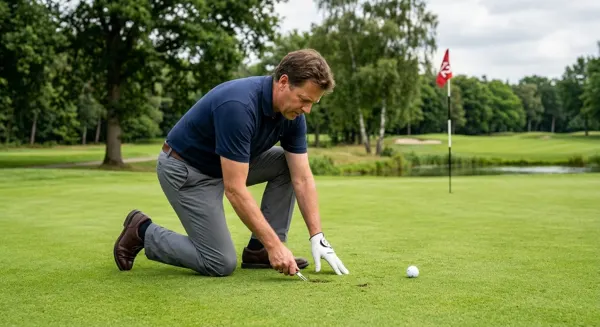
Answer: The player should repair the pitch mark
Good course care is an important part of the standards of player conduct. Players are expected to repair pitch marks, rake bunkers, and leave the course in good condition.
After playing from a bunker, what should a player do?
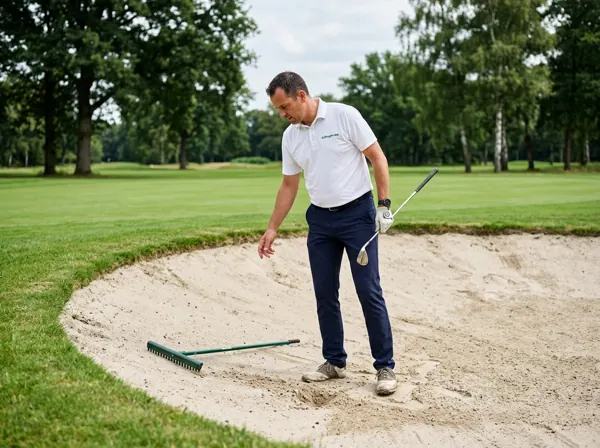
Answer: Rake the bunker so the next player finds a smooth bunker
After your stroke, you should rake the bunker so the next player finds it smooth. This is part of good conduct and caring for the course (Rule 1.2).
Your fellow player hits a bunker shot and leaves deep footprints and a divot mark behind. He walks away without raking the bunker. What's correct?
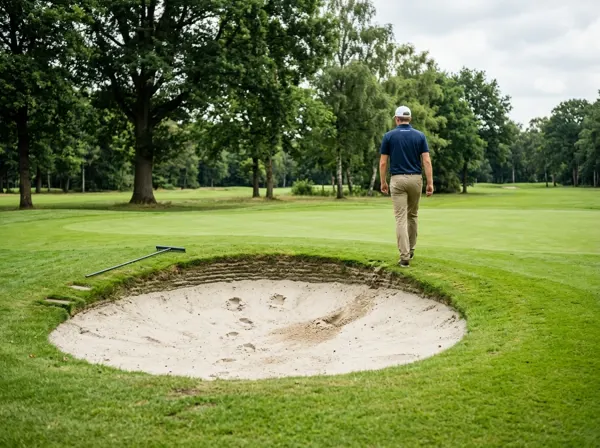
Answer: The player should rake the bunker, but there's no penalty if he doesn't
Raking the bunker is etiquette: it's the right thing to do, but there's no penalty for it under the Rules. The Committee can take action for repeated bad behavior through a code of conduct (Rule 1.2).
What do you do if you take a divot on the fairway?

Answer: Replace the divot or fill the hole with sand
Taking care of the course is part of the game: replace your divot or fill the hole with sand. The rules expect this from every player (Rule 1.2a).