Rule 10: Making Your Stroke and Asking for Advice

What this is about
Rule 10 covers how you make a stroke, and the help and advice you're allowed to get. Golf is a personal challenge.
What you need to do
- Strike the ball: hit it with a brief touch of your club. Pushing or scooping isn't allowed.
- Anchoring isn't allowed: pressing your club or forearm against your body during the swing.
- Don't stand with a foot on or over the line along which you're playing the ball.
- Wait until your ball is at rest. Only a ball moving in water, or falling off your tee, may still be played.
- Ask for advice about your stroke only from your caddie or your partner. Don't give tips to fellow players either.
- Breaking this costs the general penalty: two penalty strokes, or loss of the hole in match play.
Common mistake
Thinking you may strike a ball that's just started rolling. It must truly be at rest.
Example
Just before your putt, the wind nudges your ball slightly to the side. Wait until it comes to rest again. If you strike it while it's rolling, you get a penalty.
Practise this rule with real exam questions in the free app.
10.1 Making a Stroke
10.1a Fairly striking the ball
You must fairly strike the ball with the clubhead: a brief hit, so no pushing, scraping, or spooning. If the club accidentally hits the ball more than once during the same stroke, that counts as one stroke and you get no penalty.
10.1b Anchoring the club
You may not anchor the club when making a stroke. That means: don't press the club or the hand holding it against your body, and don't hold your forearm against your body to create a fixed pivot point. Holding the club against your hand or forearm is allowed.
10.1c Making a stroke while standing on or astride the line of play
You may not make a stroke while standing astride the line of play (one foot on each side), or with a foot on the line of play or its extension behind the ball. This bans croquet-style putting. There's no penalty if you take that stance accidentally, or to avoid standing on another player's line of play.
10.1d Playing a ball in motion
You may not make a stroke at a ball that's moving. There are three exceptions: the ball only starts moving after you've already begun your backswing, the ball falls off the tee, or the ball is moving in temporary water or in water in a penalty area.
10.2 Advice and other help
10.2a Advice
During the round, you may not give or ask for advice with another player on the course. It's allowed with your partner and your caddie. Advice is anything that could influence your choice of club, your stroke, or how you play a hole. Information that's generally known, such as where the flagstick is or where a bunker lies, is not advice. Penalty: the general penalty.
10.2b Other assistance
You may not place an object to indicate your direction, and may not ask anyone to stand on or behind your line of play to help you aim. During your stroke, no one may deliberately stand there either. You also may not receive physical assistance during a stroke, or let someone shield you from sun, rain, or wind, for example with an umbrella. Protecting yourself is fine: wearing suitable clothing or holding your own umbrella.
10.3 Caddies
10.3a Your caddie may help
A caddie may carry and transport your clubs, and give you advice and other help. You may have only one caddie at a time, and you're responsible for what your caddie does.
10.3b What a caddie may do
Your caddie may look for your ball, give you information and advice, remove loose impediments, rake bunkers, clean your ball, repair damage on the putting green, and attend or remove the flagstick. On the putting green, they may mark, lift, and replace your ball without needing your authorization. Off the green, they may lift your ball once it's clear you're going to take relief, and may only replace it if they lifted or moved it themselves. What they may never do: drop or place the ball themselves, or decide that you're taking relief. They can advise, you decide.
10.3c Caddie must not stand behind the player
From the moment you take your stance for a stroke until the stroke is made, your caddie must not deliberately stand on or close behind the extension of your line of play to help you aim. There's no penalty if you step back out of your stance and your caddie has moved away before you take your stance again.
Practice questions about Rule 10
Your fellow player asks you: "Which club did you just use for that shot?" What's the rule?
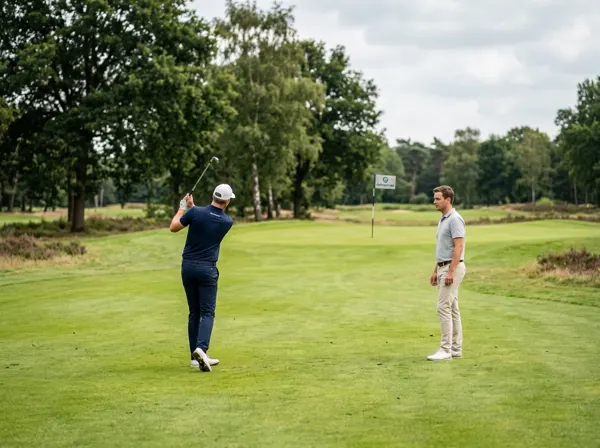
Answer: You may not tell them, this is advice and both players get a penalty
Telling someone which club you used (or asking about it) is advice under Rule 10.2a. Both the player giving the advice and the player receiving it get the general penalty. So never volunteer which club you used, unless the hole has been completed.
Are you allowed to ask a fellow player during a round: "Which club did you use for that stroke?"
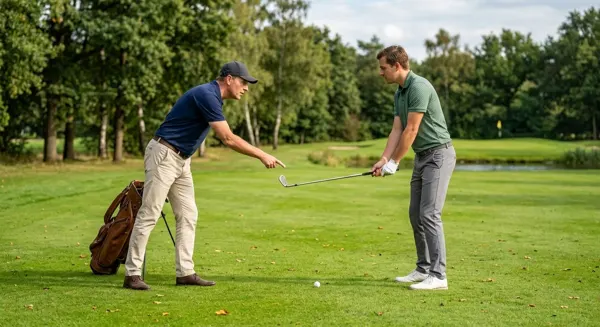
Answer: No, that's forbidden advice
Rule 10.2a forbids asking for or giving advice between players. Which club someone used counts as advice. You're allowed to share public information, such as the distance to the flagstick.
You make a stroke and your club accidentally hits the ball twice. What's the rule?
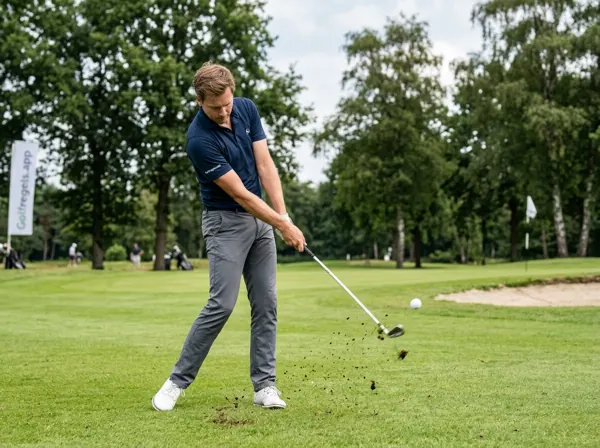
Answer: It counts as one stroke, no penalty
Since the 2019 rule change, an accidental double hit counts as one stroke, with no penalty (Rule 10.1a). You play the ball from where it comes to rest.
Are you allowed to hit the ball with both hands at the same time?
Answer: Yes, there's no restriction on how you hold the club
There are no restrictions on how you hold the club, as long as you meet the other requirements for making a stroke.
Are you allowed to ask a fellow competitor for advice during a stroke play round?
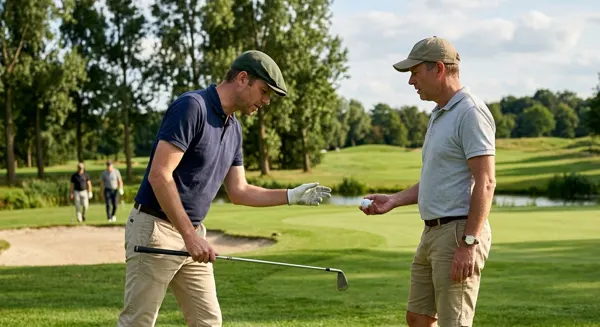
Answer: No, asking a fellow competitor for advice is not allowed (2 penalty strokes)
You may not ask for advice from a fellow competitor or anyone other than your caddie. The penalty is 2 strokes.