Rule 20: Resolving Rules Issues During Your Round

What this is about
Rule 20 explains what to do if you're unsure how a rule works during your round.
What you need to do
- Keep playing and don't hold up the game while waiting for an official.
- Match play: tell your opponent in time that you want a ruling, before either of you starts the next hole, or after the last hole before the result is final.
- Stroke play: play two balls. One your way, one the alternative way. State beforehand which ball you want to count.
- Report the situation to the committee before you return your scorecard. Fail to do so and you're disqualified.
Common mistake
Playing two balls but not reporting it afterward. Without reporting to the committee, you're disqualified.
Example
Your ball lies against something odd in the woods and there's no official around. In stroke play, you play two balls: one as it lies and one after dropping with a penalty stroke. Right after your round, you report it to the committee.

Practise this rule with real exam questions in the free app.
20.1 Resolving rules issues during a round
20.1a Players must avoid unnecessary delay
Resolve a rules question without unnecessarily delaying play. If you can't sort it out quickly, keep playing and raise the issue later.
20.1b Rules issues in match play
In match play, you and your opponent may agree how to resolve a rules issue. That agreement stands, even if it later turns out to be wrong, as long as you don't knowingly ignore a rule or penalty. If you can't agree, ask a referee or the Committee for a ruling in time: before anyone tees off on the next hole, or on the last hole before the result is final.
20.1c Rules issues in stroke play: playing two balls
In stroke play, you can't settle a rules issue by agreement. If you're unsure of the correct procedure, you may play two balls. Before you play, say which ball should count if the Rules allow the procedure you followed, and report the issue to the Committee before you return your scorecard, even if both balls score the same.
20.2 Rulings on questions under the Rules
20.2a Rulings by a referee
If a referee has been appointed, they decide questions of fact and how the Rules apply. You must accept that decision; there's no appeal to the Committee.
20.2b Rulings by the Committee
If there's no referee, or the referee refers the matter on, the Committee decides. It may gather evidence and ask players for their side of the story. That decision is binding too.
20.2c Applying the standard of proof when determining facts
To determine what happened to a ball, the standard is "known or virtually certain". Either there's conclusive evidence, or all reasonably available information makes it at least 95% likely that's what happened. If you don't reach that certainty, you can't assume it: a ball you then can't find, for example, simply counts as lost.
20.2d Incorrect application of the rules
If a ruling later turns out to be wrong, it's corrected if that's still possible. If it's no longer possible, the ruling stands. The Committee can always still correct an administrative error, such as a wrongly calculated result.
20.3 Situations not covered by the Rules
If a situation isn't covered by the Rules, the Committee decides. It considers all the circumstances and chooses a solution that's reasonable and fair, and consistent with how similar cases have been handled.
Practice questions about Rule 20
What do you do if you have a rules question during the round?

Answer: Ask the committee or referee for clarification
If you're unsure about a rule, ask the committee or referee (Rule 20.1). In stroke play, you may also play two balls and have the situation decided afterward.
You're unsure about the correct procedure during stroke play. What's a sensible approach?

Answer: Play two balls and ask the Committee for a ruling after the round
In stroke play, if you're unsure about the correct procedure, you may play two balls (Rule 20.1c). Announce which ball is to count, and report the situation to the Committee after the round. They decide your score.
In match play, you and your opponent disagree about a rule. What do you do?
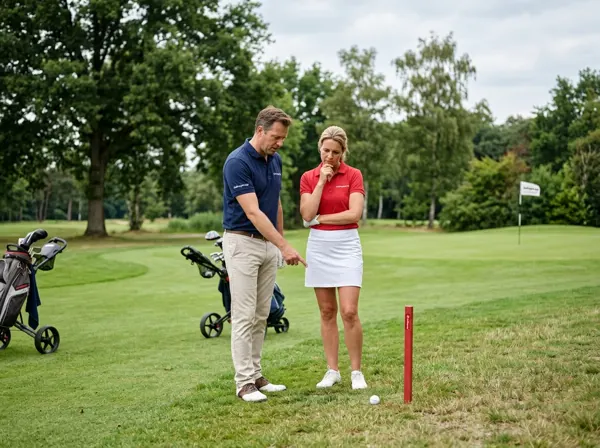
Answer: You try to work it out together or ask the Committee for a ruling
In match play, players are allowed to agree together how to resolve a rules issue, as long as they don't knowingly waive a rule (Rule 20.1b). Can't reach an agreement? Then ask the Committee for a ruling.
What do you do in stroke play if you're unsure whether you're entitled to free relief?

Answer: Play two balls and report it to the committee
If you're unsure, in stroke play you're allowed to play two balls and report the situation to the committee, who will decide which ball counts.
What do you do if two players disagree about a rules issue in stroke play?

Answer: A player who's unsure about the rules issue may play out the hole with two balls and report this to the committee.
If there's disagreement about the rules in stroke play, you may play two balls and submit the issue to the committee after the round.