Rule 7: Finding Your Ball: Searching, Seeing and Identifying

What this is about
Rule 7 covers searching for your ball and identifying it. You may take reasonable actions to find it, but no more than that.
What you need to do
- You have three minutes of search time, from the moment you start looking.
- You may carefully move aside grass, branches, and sand to find or see your ball.
- Does your ball move while searching? No penalty. Replace it on its original spot.
- Not sure it's your ball? Mark the spot first, lift it, and look. Cleaning is only allowed as much as needed to identify it.
- Lift it without marking, or clean it more than allowed, and that costs one penalty stroke.
- Go beyond what's reasonable and improve your lie or swing space as a result, and the general penalty of two penalty strokes applies (Rule 8.1a).
Common mistake
Searching so enthusiastically that you push aside branches that were in your swing. That goes beyond searching and costs you a penalty.
Example
Your ball lies in the bushes. You bend branches aside to look and find a ball. You place a tee down as a marker, lift it, and recognize your identifying mark. Then you put it back exactly where it was.

Practise this rule with real exam questions in the free app.
7.1 How to correctly search for your ball
7.1a You may take reasonable actions to find and identify your ball
You may search reasonably: pushing or bending aside grass, bushes, and branches, and moving sand and water. If something breaks as a result of a normal search, there's no penalty, even if your lie improves because of it. Go beyond what's reasonable and you get the general penalty (Rule 8.1a). You have three minutes of search time (Rule 18.2).
7.1b What to do when sand affecting the lie of your ball is moved
If you move sand while searching that affects the lie of your ball, you must restore that lie as best you can. If your ball was covered by sand, you may leave a small part of it visible. Playing without restoring the lie is the general penalty.
7.2 How to identify a ball
You may identify your ball in any way that gives certainty: you see it come to rest, you recognize your own marking, or you find a ball with the same brand, model, number and appearance in the expected spot. If an identical ball is also lying there and you don't know which one is yours, that doesn't count. If you can't identify your ball, it's lost.
7.3 Lifting a ball for identification
If you can't identify a ball just by looking at it, you may lift it. First mark the spot, and don't clean the ball beyond what's needed to identify it (on the putting green, you may always clean it). Then replace it on its original spot. Getting this wrong costs one penalty stroke.
7.4 Ball accidentally moved while searching for or trying to identify it
If your ball accidentally moves while you, your opponent, or someone else is searching for it or trying to identify it, there's no penalty. Replace it on its original spot; if you don't know exactly where that was, estimate it. If you moved the ball before the search began, that's one penalty stroke (Rule 9.4b).
Practice questions about Rule 7
Are you allowed to mark your ball with a different color to identify it better?
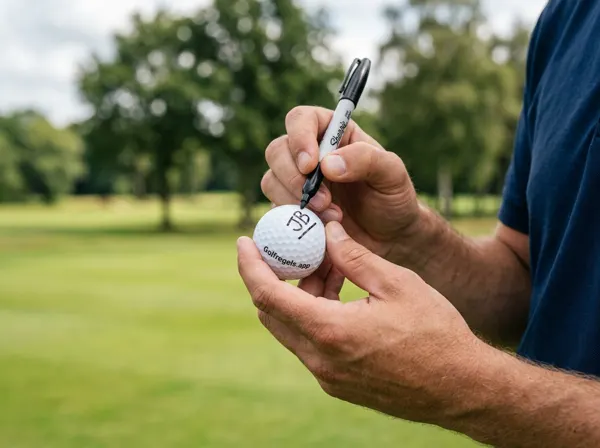
Answer: Yes, you may add any marking for identification
You're advised to mark your ball for identification. You may add any marking you like, such as a dot, line, initials, and so on.
You've been searching for your ball for 2 minutes. You find a ball but you're not sure if it's yours. What do you do?

Answer: You mark the spot, lift the ball and check the brand and number
You may lift the ball to identify it, but you must mark the spot first (Rule 7.3). Check the brand, number or your identifying mark, then put the ball back. If it's not your ball, put it back and keep searching (you still have 1 minute left).
While searching for your ball, you accidentally step on it in the long grass. What's the rule?

Answer: No penalty, but the ball must be replaced on its original spot
If you accidentally move your ball while searching for it, there's no penalty (Rule 7.4). You must replace it on its estimated original spot.
Are you allowed to identify your ball by lifting it in the rough?

Answer: Yes, after marking it and without cleaning it more than necessary for identification
You may lift your ball to identify it (Rule 7.3), as long as you mark its spot first and don't clean it more than necessary to identify it.
Are you allowed to feel around in the sand in a bunker to find your ball?
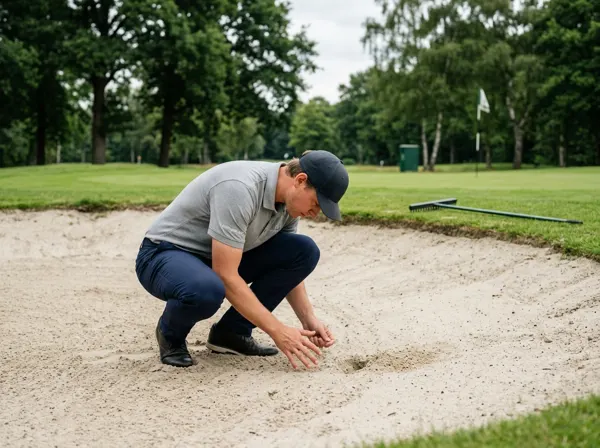
Answer: Yes, but only carefully (for example, feeling in the sand with your hand or club). If you accidentally improve the lie while doing so, there's no penalty.
You may take reasonable actions to find your ball, including carefully feeling in the sand.