Rule 14: Marking, Lifting and Dropping Your Ball
What this is about
Rule 14 explains how you mark, lift, clean, replace, and drop your ball.
What you need to do
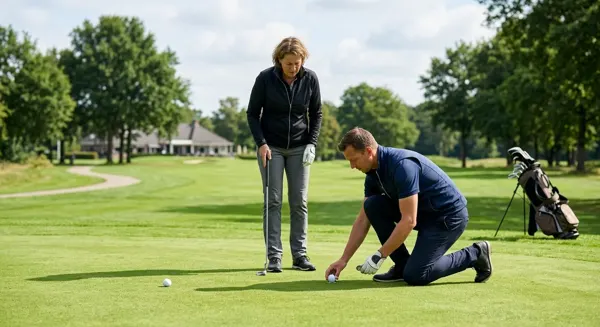
- Marking: mark the spot before lifting your ball to replace it, using a marker or a club. Remove the marker before your stroke. Forgetting or doing it wrong: one penalty stroke.
- Lifting: only you, or someone with your authorization, may lift your ball. On the green, your caddie may do it without asking. Doing it elsewhere without authorization: one penalty stroke.
- Cleaning: always allowed on the green. Elsewhere only when replacing the ball, so not when lifting it to identify it, check for damage, or because it's in the way. Cleaning when not allowed: one penalty stroke.
- Replacing: with the same ball, exactly on the marked spot. If you can't quickly find that ball, you may use another one.
- Dropping: let the ball fall from knee height. It must land in the relief area and come to rest there too.
- Play from a wrong place and it costs two penalty strokes in stroke play, or loss of the hole in match play.
Common mistake
Wiping your ball clean off the green. That's not always allowed and costs you one penalty stroke.
Example
Your ball lies covered in mud right next to the green. You pick it up and wipe it clean. That's not allowed here: one penalty stroke.

Practise this rule with real exam questions in the free app.
14.1 Marking, lifting and cleaning your ball
14.1a Marking the position of the ball
If you must lift a ball that then has to go back to the same spot, mark that spot first. Place a ball-marker (or another small object) right behind or beside the ball, or hold a club on the ground there.
14.1b Who may lift the ball
Only you may lift your ball, or someone you authorize to do so. You give that authorization each time, not once for the whole round. On the putting green, your caddie may lift your ball without your authorization.
14.1c Cleaning your ball
If you lift your ball on the putting green, you may always clean it. Elsewhere you may too, except when you lift it:
- to check whether it's cut or cracked: don't clean it
- to identify it: only as much as needed to recognize it
- because it interferes with another player's play: don't clean it
- to see whether you're entitled to relief: don't clean it
14.2 Replacing a ball on a spot
14.2a The original ball must be used
You must replace your original ball. Another ball is only allowed if the original ball can't be recovered within a few seconds with reasonable effort, is cut or cracked, has been played by someone else as a wrong ball, or if play resumes after a suspension.
14.2b Who must replace the ball, and how
Only you, or the person who lifted or moved your ball, may replace it. Set the ball down on the right spot and let go of it, so it stays there. If someone else does it, or you do it another way, that costs one penalty stroke.
14.2c What to do if the original spot has changed
If the lie of your ball has changed, for example because the spot has been dug up, you place the ball on the nearest spot with the most similar lie. That spot is within one club-length of the original spot, not nearer the hole, and in the same part of the course. If your ball was in sand, recreate the original lie as closely as possible.
14.2d What to do if the replaced ball doesn't stay in place
If a replaced ball doesn't stay in place, try again. If that doesn't work either, place the ball at the nearest spot where it does stay, not nearer the hole and in the same part of the course.
14.3 Dropping a ball in a relief area
14.3a Original ball or another ball
You may drop the original ball or use another ball.
14.3b The ball must be dropped correctly
You must drop the ball yourself, from knee height, straight down. Not thrown, rolled or placed. The ball may not touch you or your equipment before it hits the ground.
14.3c A correctly dropped ball must stay in the relief area
Your ball must come to rest in the relief area. If it rolls out, drop again. If it also rolls out after that second drop, place it at the spot where it first touched the ground on that second drop.
14.4 When your ball is back in play after dropping
Your ball is back in play as soon as you replace, drop or place it with the intent to put it into play. This applies even if you do it the wrong way or in the wrong place.
14.5 Correcting mistakes when replacing, dropping or placing a ball
If you drop or place the ball the wrong way or in the wrong place, you may correct it without penalty as long as you haven't made a stroke yet. Once you've hit the ball, you can no longer correct it without penalty; then Rule 14.7 on playing from a wrong place applies.
14.6 Playing your next stroke from where the previous stroke was made
When you must replay from the spot of your previous stroke:
- Teeing area: play from anywhere within the teeing area and you may tee the ball
- General area, penalty area, or bunker: drop within one club-length of that spot, not nearer the hole and in the same area of the course
- Putting green: place the ball on that spot
14.7 Playing from a wrong place
14.7a Place from which the ball must be played
You play every stroke from where your ball lies, unless the Rules require or allow you to play from another spot. If you play from a wrong place, you get the general penalty: two penalty strokes in stroke play, loss of hole in match play.
14.7b How to finish a hole after playing from a wrong place
In stroke play, you simply finish the hole with the ball you played from the wrong place, unless it's a serious breach. Then you must correct the mistake by playing from the right place before you tee off on the next hole. If you don't, you're disqualified.
Practice questions about Rule 14
Are you allowed to drop the ball with spin or a special throw?

Answer: No, the ball must fall straight down
You must drop the ball straight down from knee height, without spin, throwing or rolling it.
After dropping, your ball rolls outside the relief area. You drop again and the ball rolls outside the area again. What do you do now?
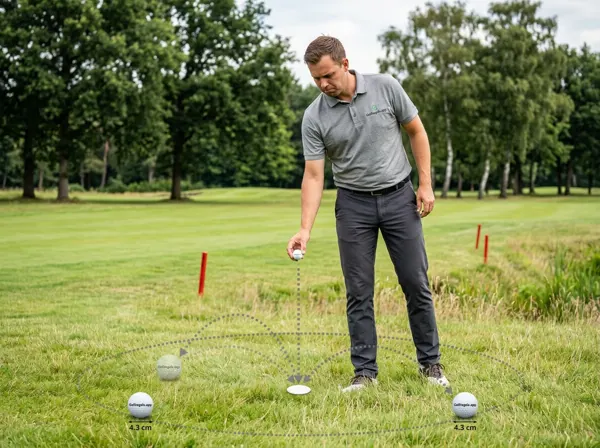
Answer: Place the ball at the spot where it first touched the ground on the second drop
If your ball rolls outside the relief area again after the second drop, you place it at the spot where it touched the ground on the second drop (Rule 14.3c). If it doesn't stay there, place it at the nearest spot where it does.
What is the correct dropping procedure?

Answer: Drop the ball from knee height while standing upright
Since 2019, you drop from knee height: let the ball fall straight down, without throwing it or giving it any spin. It must land in the relief area (Rule 14.3b). If you drop incorrectly, redo the drop before you play your stroke.
How do you mark your ball on the putting green?
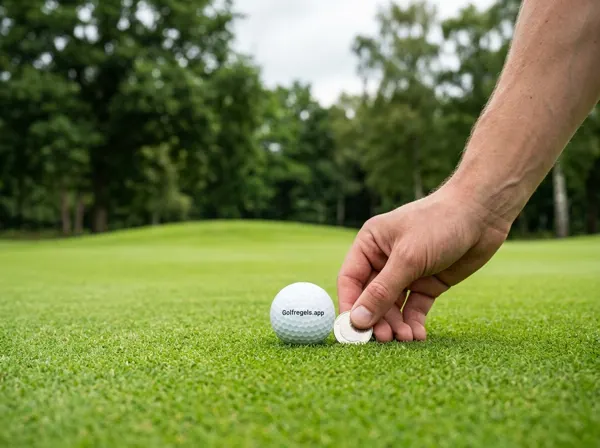
Answer: With a ball-marker directly behind the ball
You mark your ball by placing a ball-marker directly behind or next to the ball, after which you may lift the ball.
How high do you need to drop the ball from?

Answer: Knee height
Since 2019, you must drop from knee height (it used to be shoulder height). The ball must fall straight down.