Rule 16: Free Relief: Puddles, Obstructions and Embedded Ball

What this is about
Rule 16 gives you free relief from abnormal course conditions: temporary water (a puddle), ground under repair, animal holes, and immovable obstructions such as a sprinkler head. Also from a dangerous animal or an embedded ball.
What you need to do
- You may only take relief if the situation interferes with your ball, stance, or swing. Simply lying in your line of play doesn't count, except on the green.
- Find the nearest point where you're completely free of the interference. That's your reference point.
- Drop within one club-length of that point, not nearer the hole and in the same area of the course.
- All of this is free of penalty.
- If your ball lies in a penalty area, this rule doesn't apply. There, you follow Rule 17.
- You may only take free relief from an embedded ball (one sitting in its own pitch mark in the ground) in the general area, so not in a bunker or penalty area.
Common mistake
Thinking you can always take relief. If you choose an unrealistic stroke or stance yourself, that interference doesn't count.
Example
After heavy rain, your ball lies in a puddle, meaning temporary water. You find the nearest point without a puddle and drop there, free of penalty, within one club-length.

Practise this rule with real exam questions in the free app.
16.1 Abnormal course conditions (including immovable obstructions)
16.1a When you're allowed to take relief
You may take free relief if an abnormal course condition interferes with your play. That's the case if:
- your ball touches the condition or lies in or on it
- the condition physically interferes with your stance or your area of intended swing
- your ball is on the green and the condition is on your line of play
If playing would already be clearly unreasonable for another reason, there's no right to relief (see Rule 16.1f). Rule 16.1 doesn't apply in a penalty area (see Rule 17.3).
16.1b Relief for a ball in the general area
The reference point is the nearest point of complete relief in the general area. You drop within one club-length of that point, not nearer the hole, and in the general area.
16.1c Relief for a ball in a bunker
You may take free relief within the bunker: the reference point is the nearest point of complete relief in the bunker. If you'd rather drop outside the bunker, that costs one penalty stroke, dropping back on the line from the hole through the ball.
16.1d Relief for a ball on the putting green
You place your ball at the nearest point of complete relief. That point may be on the putting green or in the general area.
16.1e Relief when a ball isn't found but is in an abnormal course condition
If it's known or virtually certain that your ball is in an abnormal course condition, but you can't find it, you may take free relief. The reference point is the estimated spot where your ball last crossed the edge of that condition.
16.1f No relief if playing the ball is clearly unreasonable
You have no right to relief if playing the ball is clearly unreasonable for a reason other than the abnormal course condition.
16.2 Dangerous animals
If a dangerous animal near your ball could seriously injure you, think snakes, bees, or crocodiles, you may take relief. Outside a penalty area, that's free relief under Rule 16.1b, 16.1c, or 16.1d. If your ball is in a penalty area, you may take free relief within that penalty area, or take relief outside it for one penalty stroke under Rule 17.1c (with a red penalty area, also laterally under Rule 17.1d).
16.3 Embedded ball
If your ball is embedded in its own pitch-mark in the general area (partly below ground level), you may take free relief. The reference point is the spot right behind where the ball was embedded. Drop the ball within one club-length of this reference point. This rule doesn't apply in bunkers or penalty areas. There's also no free relief if the ball is embedded in sand in a part of the general area that isn't cut to fairway height or less.
Practice questions about Rule 16
Are you allowed to pick up your ball to check whether you're entitled to free relief?
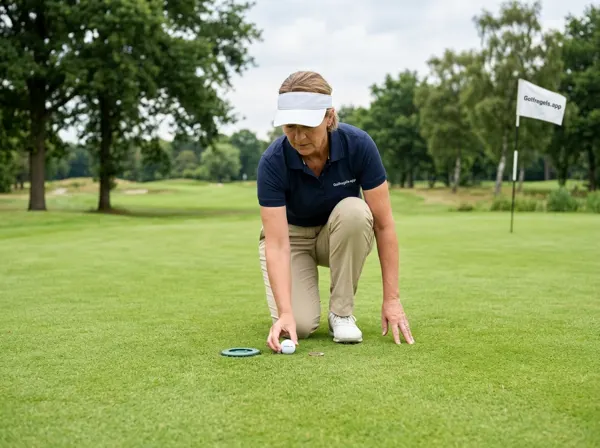
Answer: Yes, if you have a reasonable reason and mark the spot
You're allowed to lift your ball to check whether you're entitled to free relief (Rule 16.4), as long as you mark its spot first.
Your ball is in a bunker with temporary water (a puddle after the rain). You want to take relief. What are your options?
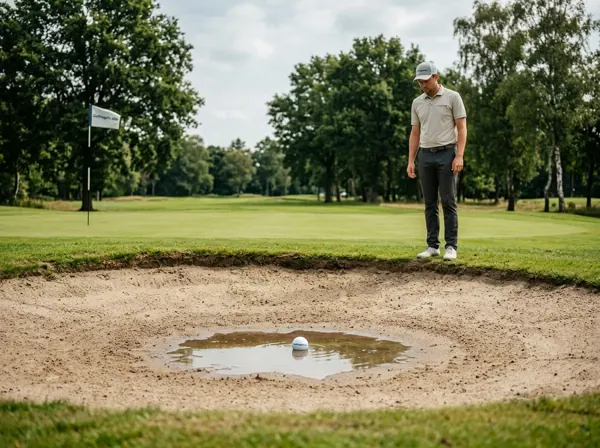
Answer: You may take free relief within the bunker, or take relief outside the bunker with one penalty stroke
With temporary water in a bunker you have two options (Rule 16.1c): drop for free on a drier spot in the bunker, or drop behind the bunker on the back-on-the-line with one penalty stroke.
Your ball is on a cart path. What is the correct procedure?

Answer: Determine the nearest point of complete relief, drop within 1 club-length, not nearer the hole, free relief
For an immovable obstruction (cart path), you determine the nearest point of complete relief and drop within 1 club-length of that point, not nearer the hole.
Your ball lies in the general area in a hole made by a mole. How do you take free relief?

Answer: Find the nearest point of complete relief (NPCR) in the general area and drop within one club-length, not nearer the hole.
A hole made by an animal is an abnormal course condition, so you get free relief (Rule 16.1b). Find the nearest point of complete relief (NPCR) in the general area and drop within one club-length, not nearer the hole.
Your ball comes to rest in an area marked with blue stakes, indicating ground under repair (GUR). What is the correct procedure to take free relief under the Rules of Golf?
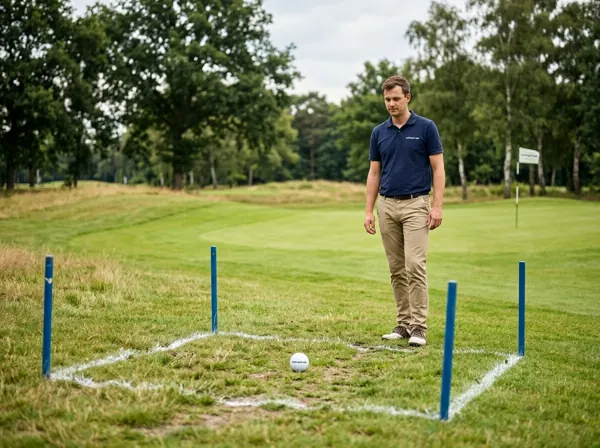
Answer: Find the nearest point of complete relief (NPCR), not nearer the hole, and drop within one club-length, completely clear of the GUR.
For ground under repair (GUR) you get free relief (Rule 16.1b). Find the nearest point of complete relief (NPCR) in the general area, not nearer the hole, and drop within one club-length, completely clear of the GUR.